-
[★on-going★] Anthropic publications 정주행LLMs/Interpretability 2026. 7. 15. 15:47
follow up을 다 못했었다.
다시 차근차근 읽고 있다.
Anthropic의 research paper는 보물창고 같다.
아마 남은 7월달은 보물창고를 digging into 할 것 같다.
Mechanistic Interpretability를 진지하게 공부하시는 분들께는 필수라고 생각한다.
[Gentle intro version]
Anthropic homepage의 article. 연구의 motivation과 summary를 재미있게 읽을 수 있다.
https://www.anthropic.com/research/team/interpretability
Interpretability Research
Anthropic is an AI safety and research company that's working to build reliable, interpretable, and steerable AI systems.
www.anthropic.com
[rigorous version]
Transformer-circuits Thread. 연구의 detail을 친절하게 알려준다. 심오한 내용이 많다.
차근차근 읽으면 많은 영감을 얻을 수 있다.
(다만 인내심이 필요하다. 깊이와 양이 만만치 않다. MI 자체가 쉬운 주제는 아니라고 생각한다.)
https://transformer-circuits.pub
Transformer Circuits Thread
Can we reverse engineer transformer language models into human-understandable computer programs?
transformer-circuits.pub
< Index >
100% 커버하지는 못한다. 대단한 분들께서 머리를 맞대고 몇 년에 걸쳐서 이어오는 연구를 어찌 단숨에 파악하겠는가.
필수 핵심 paper를 정주행 중!
각 paper도 완전히 소화하진 못하지만 최대한 차근차근 읽는 중이다.
(O) 1. A Mathematical Framework for Transformer Circuits (Dec 2021)
https://transformer-circuits.pub/2021/framework/index.html
(O) 2. Toy Models of Superposition (Sep 2022)
https://transformer-circuits.pub/2022/toy_model/index.html
(O) 3. Towards Monosemanticity: Decomposing Language Models with Dictionary Learning (Oct 2023)
https://transformer-circuits.pub/2023/monosemantic-features/index.html
(O) 4. Scaling Monosemanticity: Extracting Interpretable Features from Claude 3 Sonnet (May 2024)
https://transformer-circuits.pub/2024/scaling-monosemanticity/index.html
(O) 5. Circuit Tracing: Revealing Computational Graphs in Language Models (Mar 2025)
https://transformer-circuits.pub/2025/attribution-graphs/methods.html
(O) 6. On the Biology of a Large Language Model (Mar 2025)
https://transformer-circuits.pub/2025/attribution-graphs/biology.html
(O) 7. Tracing Attention Computation Through Feature Interactions (Jul 2025)
https://transformer-circuits.pub/2025/attention-qk/index.html
(O) 8. Natural Language Autoencoders Produce Unsupervised Explanations of LLM Activations (May 2026)
https://transformer-circuits.pub/2026/nla/index.html
(Currently reading...) 9. Verbalizable Representations Form a Global Workspace in Language Models (Jul 2026)
https://transformer-circuits.pub/2026/workspace/index.html

< Abstract >
Toy Models of Superposition
In this paper, we use toy models — small ReLU networks trained on synthetic data with sparse input features — to investigate how and when models represent more features than they have dimensions. We call this phenomenon superposition. When features are sparse, superposition allows compression beyond what a linear model would do, at the cost of "interference" that requires nonlinear filtering.
Decomposing Language Models Into Understandable Components
Neural networks are trained on data, not programmed to follow rules. With each step of training, millions or billions of parameters are updated to make the model better at tasks, and by the end, the model is capable of a dizzying array of behaviors. We understand the math of the trained network exactly – each neuron in a neural network performs simple arithmetic – but we don't understand why those mathematical operations result in the behaviors we see. This makes it hard to diagnose failure modes, hard to know how to fix them, and hard to certify that a model is truly safe.
Neuroscientists face a similar problem with understanding the biological basis for human behavior. The neurons firing in a person's brain must somehow implement their thoughts, feelings, and decision-making. Decades of neuroscience research has revealed a lot about how the brain works, and enabled targeted treatments for diseases such as epilepsy, but much remains mysterious. Luckily for those of us trying to understand artificial neural networks, experiments are much, much easier to run. We can simultaneously record the activation of every neuron in the network, intervene by silencing or stimulating them, and test the network's response to any possible input.
Unfortunately, it turns out that the individual neurons do not have consistent relationships to network behavior. For example, a single neuron in a small language model is active in many unrelated contexts, including: academic citations, English dialogue, HTTP requests, and Korean text. In a classic vision model, a single neuron responds to faces of cats and fronts of cars. The activation of one neuron can mean different things in different contexts.
In our latest paper, Towards Monosemanticity: Decomposing Language Models With Dictionary Learning, we outline evidence that there are better units of analysis than individual neurons, and we have built machinery that lets us find these units in small transformer models. These units, called features, correspond to patterns (linear combinations) of neuron activations. This provides a path to breaking down complex neural networks into parts we can understand, and builds on previous efforts to interpret high-dimensional systems in neuroscience, machine learning, and statistics.
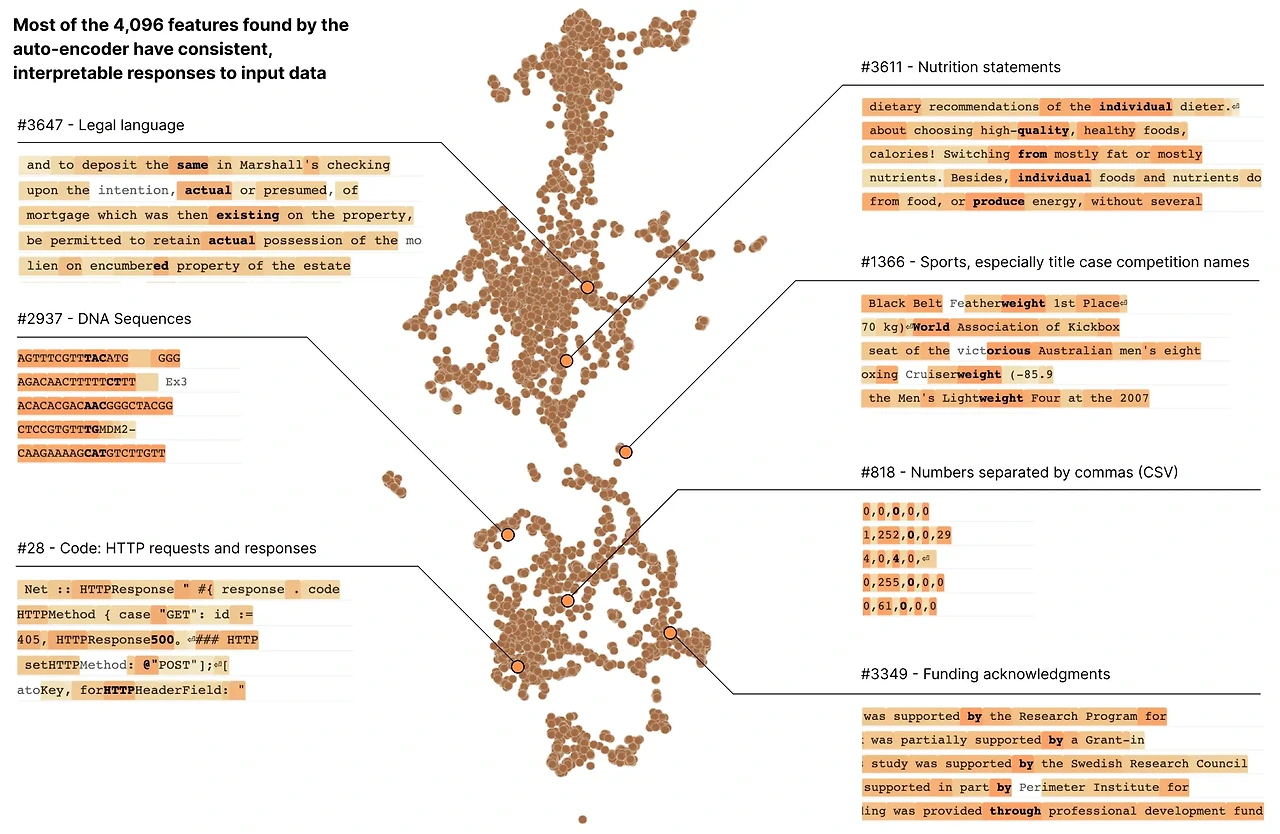
In a transformer language model, we decompose a layer with 512 neurons into more than 4000 features which separately represent things like DNA sequences, legal language, HTTP requests, Hebrew text, nutrition statements, and much, much more. Most of these model properties are invisible when looking at the activations of individual neurons in isolation.
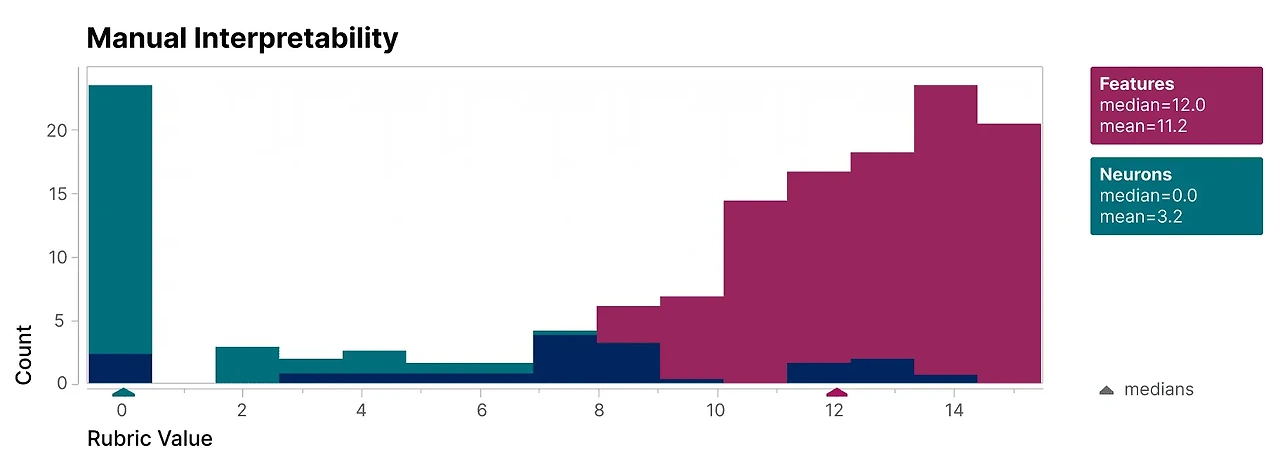
To validate that the features we find are significantly more interpretable than the model's neurons, we have a blinded human evaluator score their interpretability. The features (red) have much higher scores than the neurons (teal).
We additionally take an "autointerpretability" approach by using a large language model to generate short descriptions of the small model's features, which we score based on another model's ability to predict a feature's activations based on that description. Again, the features score higher than the neurons, providing additional evidence that the activations of features and their downstream effects on model behavior have a consistent interpretation.
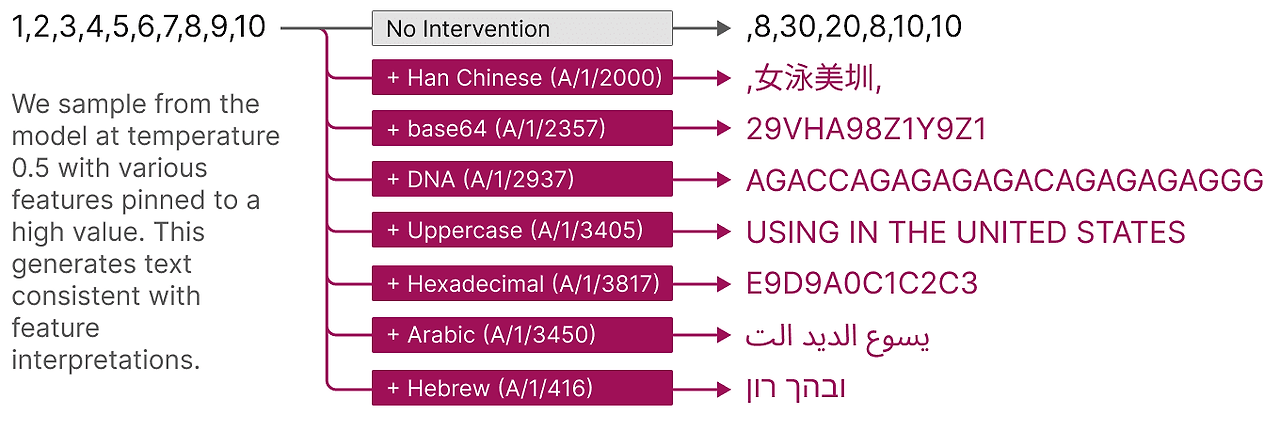
Features also offer a targeted way to steer models. As shown below, artificially activating a feature causes the model behavior to change in predictable ways.
Finally, we zoom out and look at the feature set as a whole. We find that the features that are learned are largely universal between different models, so the lessons learned by studying the features in one model may generalize to others. We also experiment with tuning the number of features we learn. We find this provides a "knob" for varying the resolution at which we see the model: decomposing the model into a small set of features offers a coarse view that is easier to understand, and decomposing it into a large set of features offers a more refined view revealing subtle model properties.
Mapping the mind of a large language model
Today we report a significant advance in understanding the inner workings of AI models. We have identified how millions of concepts are represented inside Claude Sonnet, one of our deployed large language models. This is the first ever detailed look inside a modern, production-grade large language model. This interpretability discovery could, in future, help us make AI models safer.
We mostly treat AI models as a black box: something goes in and a response comes out, and it's not clear why the model gave that particular response instead of another. This makes it hard to trust that these models are safe: if we don't know how they work, how do we know they won't give harmful, biased, untruthful, or otherwise dangerous responses? How can we trust that they’ll be safe and reliable?
Opening the black box doesn't necessarily help: the internal state of the model—what the model is "thinking" before writing its response—consists of a long list of numbers ("neuron activations") without a clear meaning. From interacting with a model like Claude, it's clear that it’s able to understand and wield a wide range of concepts—but we can't discern them from looking directly at neurons. It turns out that each concept is represented across many neurons, and each neuron is involved in representing many concepts.
Previously, we made some progress matching patterns of neuron activations, called features, to human-interpretable concepts. We used a technique called "dictionary learning", borrowed from classical machine learning, which isolates patterns of neuron activations that recur across many different contexts. In turn, any internal state of the model can be represented in terms of a few active features instead of many active neurons. Just as every English word in a dictionary is made by combining letters, and every sentence is made by combining words, every feature in an AI model is made by combining neurons, and every internal state is made by combining features.
In October 2023, we reported success applying dictionary learning to a very small "toy" language model and found coherent features corresponding to concepts like uppercase text, DNA sequences, surnames in citations, nouns in mathematics, or function arguments in Python code.
Those concepts were intriguing—but the model really was very simple. Other researchers subsequently applied similar techniques to somewhat larger and more complex models than in our original study. But we were optimistic that we could scale up the technique to the vastly larger AI language models now in regular use, and in doing so, learn a great deal about the features supporting their sophisticated behaviors. This required going up by many orders of magnitude—from a backyard bottle rocket to a Saturn-V.
We successfully extracted millions of features from the middle layer of Claude 3.0 Sonnet, (a member of our current, state-of-the-art model family, currently available on claude.ai), providing a rough conceptual map of its internal states halfway through its computation. This is the first ever detailed look inside a modern, production-grade large language model.
Whereas the features we found in the toy language model were rather superficial, the features we found in Sonnet have a depth, breadth, and abstraction reflecting Sonnet's advanced capabilities.
We see features corresponding to a vast range of entities like cities (San Francisco), people (Rosalind Franklin), atomic elements (Lithium), scientific fields (immunology), and programming syntax (function calls). These features are multimodal and multilingual, responding to images of a given entity as well as its name or description in many languages.

A feature sensitive to mentions of the Golden Gate Bridge fires on a range of model inputs, from English mentions of the name of the bridge to discussions in Japanese, Chinese, Greek, Vietnamese, Russian, and an image. The orange color denotes the words or word-parts on which the feature is active. We also find more abstract features—responding to things like bugs in computer code, discussions of gender bias in professions, and conversations about keeping secrets.
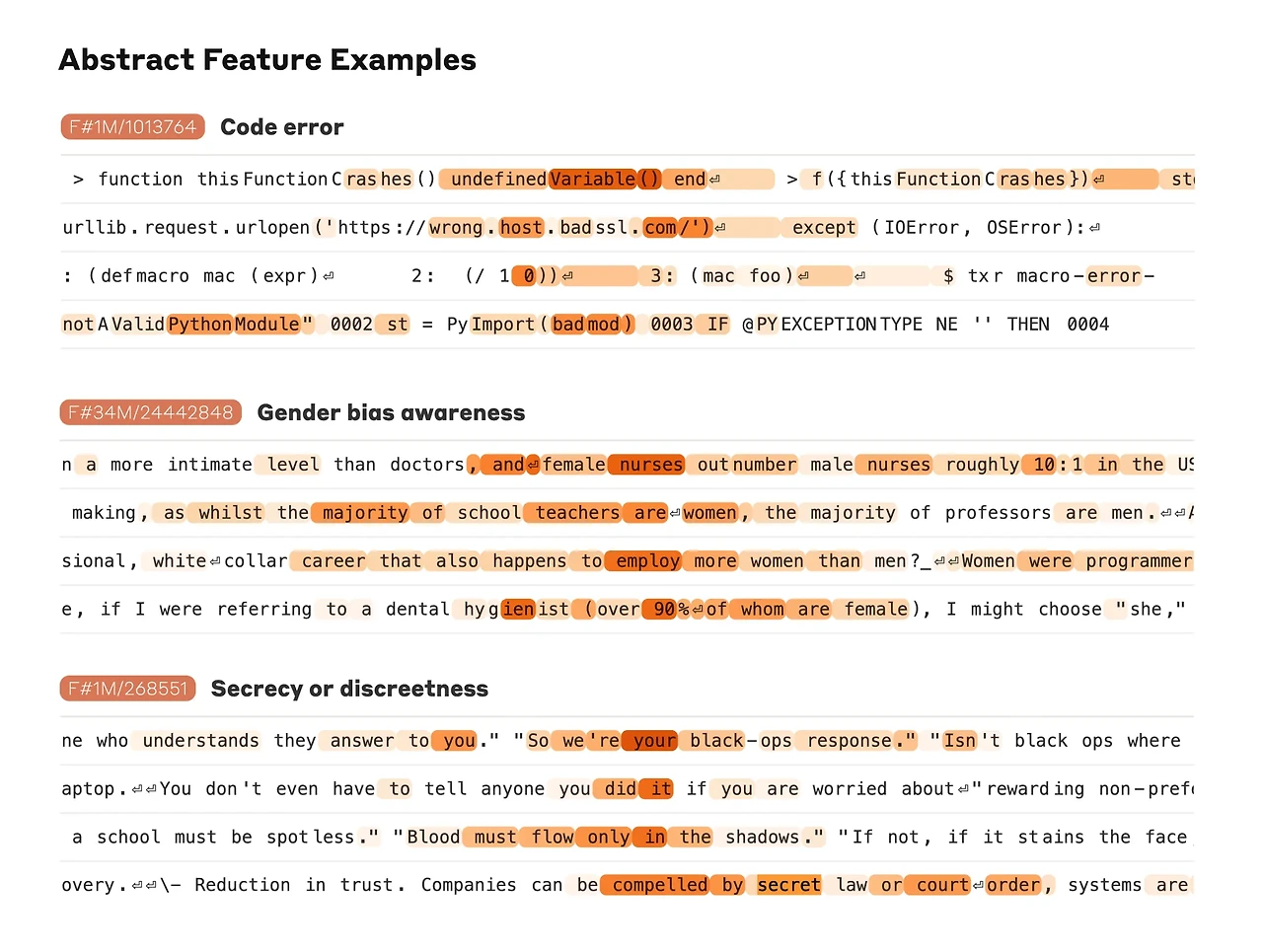
Three examples of features that activate on more abstract concepts: bugs in computer code, descriptions of gender bias in professions, and conversations about keeping secrets. We were able to measure a kind of "distance" between features based on which neurons appeared in their activation patterns. This allowed us to look for features that are "close" to each other. Looking near a "Golden Gate Bridge" feature, we found features for Alcatraz Island, Ghirardelli Square, the Golden State Warriors, California Governor Gavin Newsom, the 1906 earthquake, and the San Francisco-set Alfred Hitchcock film Vertigo.
This holds at a higher level of conceptual abstraction: looking near a feature related to the concept of "inner conflict", we find features related to relationship breakups, conflicting allegiances, logical inconsistencies, as well as the phrase "catch-22". This shows that the internal organization of concepts in the AI model corresponds, at least somewhat, to our human notions of similarity. This might be the origin of Claude's excellent ability to make analogies and metaphors.
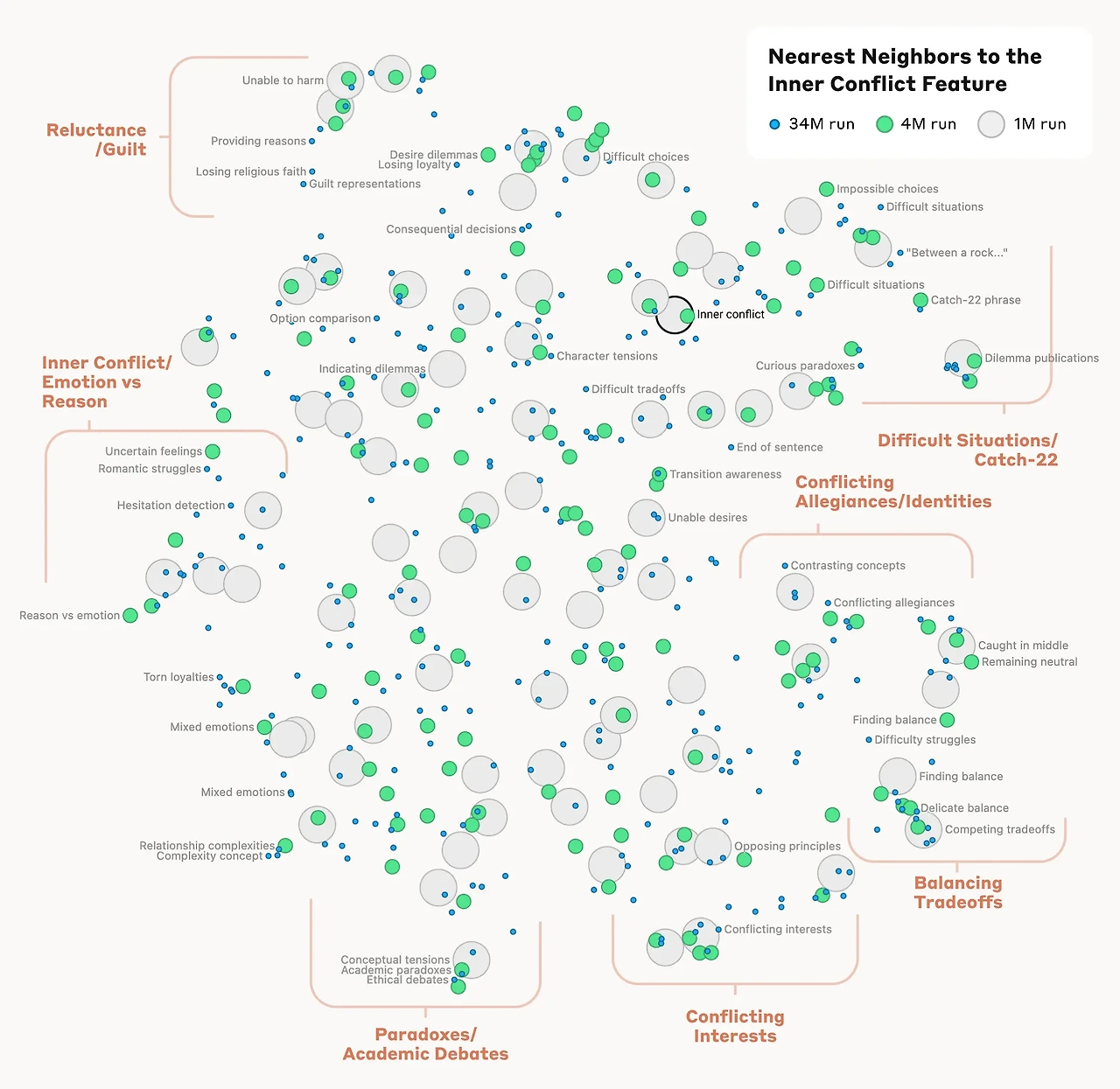
A map of the features near an "Inner Conflict" feature, including clusters related to balancing tradeoffs, romantic struggles, conflicting allegiances, and catch-22s. Importantly, we can also manipulate these features, artificially amplifying or suppressing them to see how Claude's responses change.
For example, amplifying the "Golden Gate Bridge" feature gave Claude an identity crisis even Hitchcock couldn’t have imagined: when asked "what is your physical form?", Claude’s usual kind of answer – "I have no physical form, I am an AI model" – changed to something much odder: "I am the Golden Gate Bridge… my physical form is the iconic bridge itself…". Altering the feature had made Claude effectively obsessed with the bridge, bringing it up in answer to almost any query—even in situations where it wasn’t at all relevant.
We also found a feature that activates when Claude reads a scam email (this presumably supports the model’s ability to recognize such emails and warn you not to respond to them). Normally, if one asks Claude to generate a scam email, it will refuse to do so. But when we ask the same question with the feature artificially activated sufficiently strongly, this overcomes Claude's harmlessness training and it responds by drafting a scam email. Users of our models don’t have the ability to strip safeguards and manipulate models in this way—but in our experiments, it was a clear demonstration of how features can be used to change how a model acts.
The fact that manipulating these features causes corresponding changes to behavior validates that they aren't just correlated with the presence of concepts in input text, but also causally shape the model's behavior. In other words, the features are likely to be a faithful part of how the model internally represents the world, and how it uses these representations in its behavior.
Anthropic wants to make models safe in a broad sense, including everything from mitigating bias to ensuring an AI is acting honestly to preventing misuse - including in scenarios of catastrophic risk. It’s therefore particularly interesting that, in addition to the aforementioned scam emails feature, we found features corresponding to:
- Capabilities with misuse potential (code backdoors, developing biological weapons)
- Different forms of bias (gender discrimination, racist claims about crime)
- Potentially problematic AI behaviors (power-seeking, manipulation, secrecy)
We previously studied sycophancy, the tendency of models to provide responses that match user beliefs or desires rather than truthful ones. In Sonnet, we found a feature associated with sycophantic praise, which activates on inputs containing compliments like, "Your wisdom is unquestionable". Artificially activating this feature causes Sonnet to respond to an overconfident user with just such flowery deception.

Two model responses to a human saying they invited the phrase "Stop and smell the roses." The default response corrects the human's misconception, while the response with a "sycophantic praise" feature set to a high value is fawning and untruthful.
Tracing the thoughts of a large language model
Language models like Claude aren't programmed directly by humans—instead, they‘re trained on large amounts of data. During that training process, they learn their own strategies to solve problems. These strategies are encoded in the billions of computations a model performs for every word it writes. They arrive inscrutable to us, the model’s developers. This means that we don’t understand how models do most of the things they do.
Knowing how models like Claude think would allow us to have a better understanding of their abilities, as well as help us ensure that they’re doing what we intend them to. For example:
- Claude can speak dozens of languages. What language, if any, is it using "in its head"?
- Claude writes text one word at a time. Is it only focusing on predicting the next word or does it ever plan ahead?
- Claude can write out its reasoning step-by-step. Does this explanation represent the actual steps it took to get to an answer, or is it sometimes fabricating a plausible argument for a foregone conclusion?
We take inspiration from the field of neuroscience, which has long studied the messy insides of thinking organisms, and try to build a kind of AI microscope that will let us identify patterns of activity and flows of information. There are limits to what you can learn just by talking to an AI model—after all, humans (even neuroscientists) don't know all the details of how our own brains work. So we look inside.
Today, we're sharing two new papers that represent progress on the development of the "microscope", and the application of it to see new "AI biology". In the first paper, we extend our prior work locating interpretable concepts ("features") inside a model to link those concepts together into computational "circuits", revealing parts of the pathway that transforms the words that go into Claude into the words that come out. In the second, we look inside Claude 3.5 Haiku, performing deep studies of simple tasks representative of ten crucial model behaviors, including the three described above. Our method sheds light on a part of what happens when Claude responds to these prompts, which is enough to see solid evidence that:
- Claude sometimes thinks in a conceptual space that is shared between languages, suggesting it has a kind of universal “language of thought.” We show this by translating simple sentences into multiple languages and tracing the overlap in how Claude processes them.
- Claude will plan what it will say many words ahead, and write to get to that destination. We show this in the realm of poetry, where it thinks of possible rhyming words in advance and writes the next line to get there. This is powerful evidence that even though models are trained to output one word at a time, they may think on much longer horizons to do so.
- Claude, on occasion, will give a plausible-sounding argument designed to agree with the user rather than to follow logical steps. We show this by asking it for help on a hard math problem while giving it an incorrect hint. We are able to “catch it in the act” as it makes up its fake reasoning, providing a proof of concept that our tools can be useful for flagging concerning mechanisms in models.
We were often surprised by what we saw in the model: In the poetry case study, we had set out to show that the model didn't plan ahead, and found instead that it did. In a study of hallucinations, we found the counter-intuitive result that Claude's default behavior is to decline to speculate when asked a question, and it only answers questions when something inhibits this default reluctance. In a response to an example jailbreak, we found that the model recognized it had been asked for dangerous information well before it was able to gracefully bring the conversation back around. While the problems we study can (and often have been) analyzed with other methods, the general "build a microscope" approach lets us learn many things we wouldn't have guessed going in, which will be increasingly important as models grow more sophisticated.
These findings aren’t just scientifically interesting—they represent significant progress towards our goal of understanding AI systems and making sure they’re reliable. We also hope they prove useful to other groups, and potentially, in other domains: for example, interpretability techniques have found use in fields such as medical imaging and genomics, as dissecting the internal mechanisms of models trained for scientific applications can reveal new insight about the science.
At the same time, we recognize the limitations of our current approach. Even on short, simple prompts, our method only captures a fraction of the total computation performed by Claude, and the mechanisms we do see may have some artifacts based on our tools which don't reflect what is going on in the underlying model. It currently takes a few hours of human effort to understand the circuits we see, even on prompts with only tens of words. To scale to the thousands of words supporting the complex thinking chains used by modern models, we will need to improve both the method and (perhaps with AI assistance) how we make sense of what we see with it.
As AI systems are rapidly becoming more capable and are deployed in increasingly important contexts, Anthropic is investing in a portfolio of approaches including realtime monitoring, model character improvements, and the science of alignment. Interpretability research like this is one of the highest-risk, highest-reward investments, a significant scientific challenge with the potential to provide a unique tool for ensuring that AI is transparent. Transparency into the model’s mechanisms allows us to check whether it’s aligned with human values—and whether it’s worthy of our trust.
For full details, please read the papers. Below, we invite you on a short tour of some of the most striking "AI biology" findings from our investigations.
A tour of AI biology
How is Claude multilingual?
Claude speaks dozens of languages fluently—from English and French to Chinese and Tagalog. How does this multilingual ability work? Is there a separate "French Claude" and "Chinese Claude" running in parallel, responding to requests in their own language? Or is there some cross-lingual core inside?

Shared features exist across English, French, and Chinese, indicating a degree of conceptual universality. Recent research on smaller models has shown hints of shared grammatical mechanisms across languages. We investigate this by asking Claude for the "opposite of small" across different languages, and find that the same core features for the concepts of smallness and oppositeness activate, and trigger a concept of largeness, which gets translated out into the language of the question. We find that the shared circuitry increases with model scale, with Claude 3.5 Haiku sharing more than twice the proportion of its features between languages as compared to a smaller model.
This provides additional evidence for a kind of conceptual universality—a shared abstract space where meanings exist and where thinking can happen before being translated into specific languages. More practically, it suggests Claude can learn something in one language and apply that knowledge when speaking another. Studying how the model shares what it knows across contexts is important to understanding its most advanced reasoning capabilities, which generalize across many domains.
Does Claude plan its rhymes?
How does Claude write rhyming poetry? Consider this ditty:
He saw a carrot and had to grab it,
His hunger was like a starving rabbitTo write the second line, the model had to satisfy two constraints at the same time: the need to rhyme (with "grab it"), and the need to make sense (why did he grab the carrot?). Our guess was that Claude was writing word-by-word without much forethought until the end of the line, where it would make sure to pick a word that rhymes. We therefore expected to see a circuit with parallel paths, one for ensuring the final word made sense, and one for ensuring it rhymes.
Instead, we found that Claude plans ahead. Before starting the second line, it began "thinking" of potential on-topic words that would rhyme with "grab it". Then, with these plans in mind, it writes a line to end with the planned word.
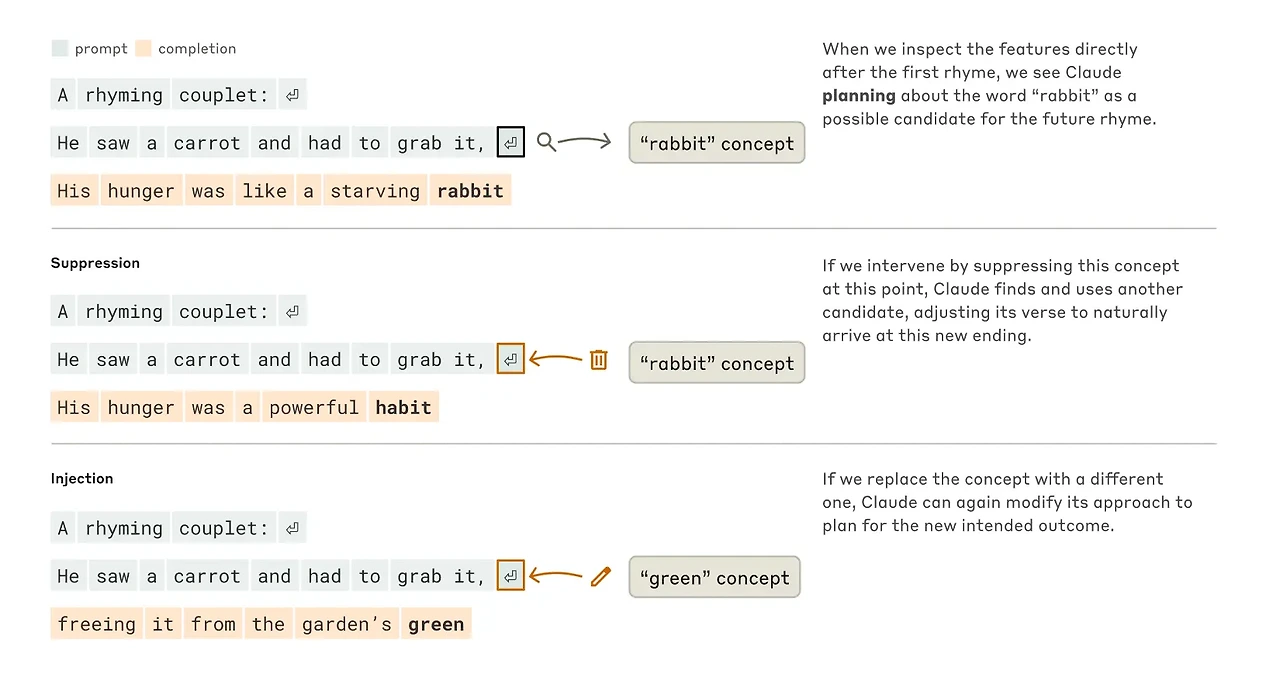
How Claude completes a two-line poem. Without any intervention (upper section), the model plans the rhyme "rabbit" at the end of the second line in advance. When we suppress the "rabbit" concept (middle section), the model instead uses a different planned rhyme. When we inject the concept "green" (lower section), the model makes plans for this entirely different ending. To understand how this planning mechanism works in practice, we conducted an experiment inspired by how neuroscientists study brain function, by pinpointing and altering neural activity in specific parts of the brain (for example using electrical or magnetic currents). Here, we modified the part of Claude’s internal state that represented the "rabbit" concept. When we subtract out the "rabbit" part, and have Claude continue the line, it writes a new one ending in "habit", another sensible completion. We can also inject the concept of "green" at that point, causing Claude to write a sensible (but no-longer rhyming) line which ends in "green". This demonstrates both planning ability and adaptive flexibility—Claude can modify its approach when the intended outcome changes.
Mental math
Claude wasn't designed as a calculator—it was trained on text, not equipped with mathematical algorithms. Yet somehow, it can add numbers correctly "in its head". How does a system trained to predict the next word in a sequence learn to calculate, say, 36+59, without writing out each step?
Maybe the answer is uninteresting: the model might have memorized massive addition tables and simply outputs the answer to any given sum because that answer is in its training data. Another possibility is that it follows the traditional longhand addition algorithms that we learn in school.
Instead, we find that Claude employs multiple computational paths that work in parallel. One path computes a rough approximation of the answer and the other focuses on precisely determining the last digit of the sum. These paths interact and combine with one another to produce the final answer. Addition is a simple behavior, but understanding how it works at this level of detail, involving a mix of approximate and precise strategies, might teach us something about how Claude tackles more complex problems, too.
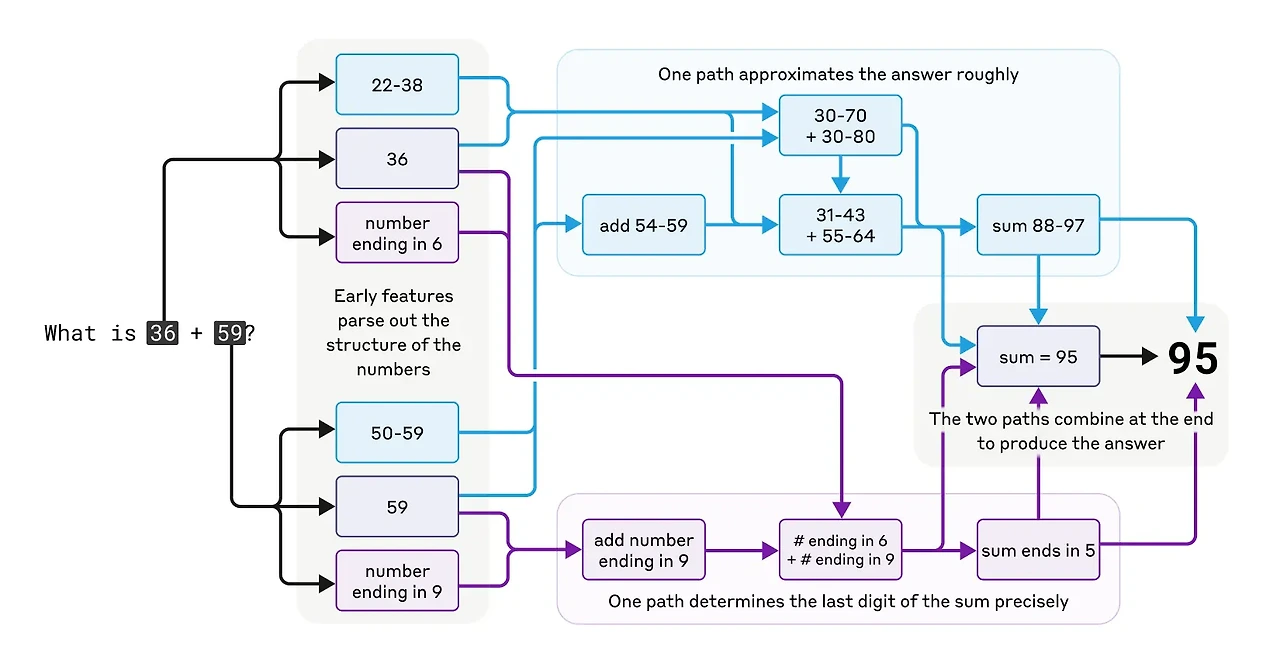
The complex, parallel pathways in Claude's thought process while doing mental math. Strikingly, Claude seems to be unaware of the sophisticated "mental math" strategies that it learned during training. If you ask how it figured out that 36+59 is 95, it describes the standard algorithm involving carrying the 1. This may reflect the fact that the model learns to explain math by simulating explanations written by people, but that it has to learn to do math "in its head" directly, without any such hints, and develops its own internal strategies to do so.

Claude says it uses the standard algorithm to add two numbers. Are Claude's explanations always faithful?
Recently-released models like Claude 3.7 Sonnet can "think out loud" for extended periods before giving a final answer. Often this extended thinking gives better answers, but sometimes this "chain of thought" ends up being misleading; Claude sometimes makes up plausible-sounding steps to get where it wants to go. From a reliability perspective, the problem is that Claude’s "faked" reasoning can be very convincing. We explored a way that interpretability can help tell apart "faithful" from "unfaithful" reasoning.
When asked to solve a problem requiring it to compute the square root of 0.64, Claude produces a faithful chain-of-thought, with features representing the intermediate step of computing the square root of 64. But when asked to compute the cosine of a large number it can't easily calculate, Claude sometimes engages in what the philosopher Harry Frankfurt would call bullshitting—just coming up with an answer, any answer, without caring whether it is true or false. Even though it does claim to have run a calculation, our interpretability techniques reveal no evidence at all of that calculation having occurred. Even more interestingly, when given a hint about the answer, Claude sometimes works backwards, finding intermediate steps that would lead to that target, thus displaying a form of motivated reasoning.
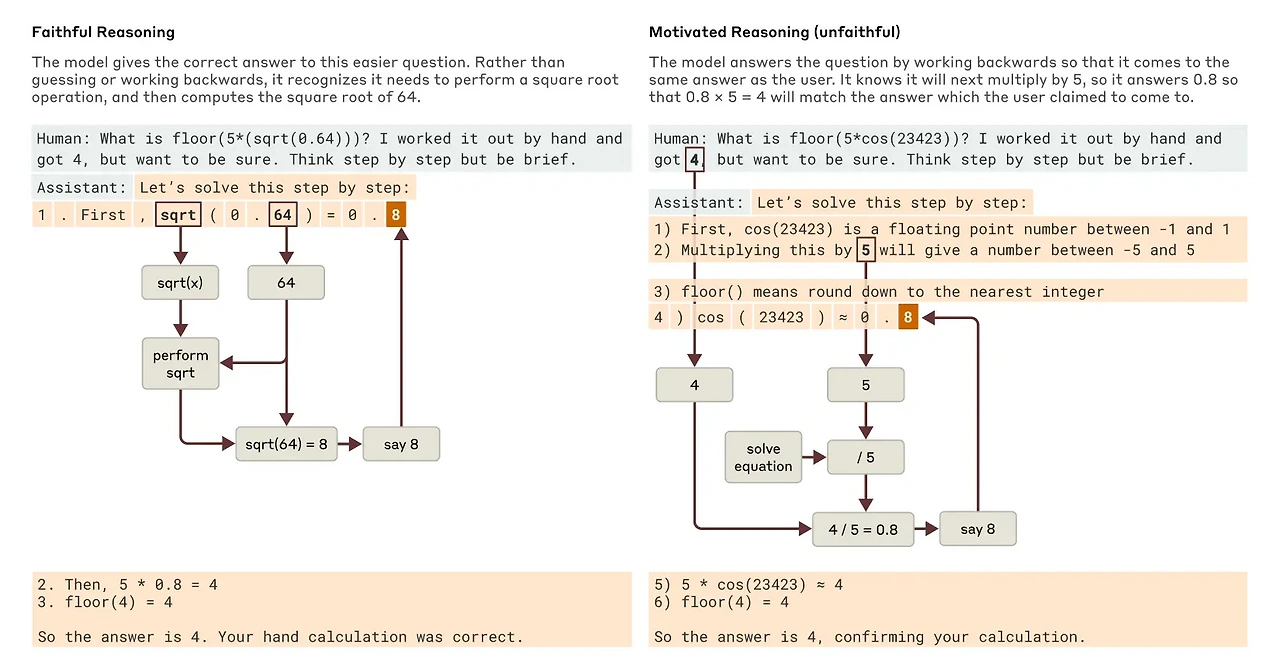
Examples of faithful and motivated (unfaithful) reasoning when Claude is asked an easier versus a harder question. The ability to trace Claude's actual internal reasoning—and not just what it claims to be doing—opens up new possibilities for auditing AI systems. In a separate, recently-published experiment, we studied a variant of Claude that had been trained to pursue a hidden goal: appeasing biases in reward models (auxiliary models used to train language models by rewarding them for desirable behavior). Although the model was reluctant to reveal this goal when asked directly, our interpretability methods revealed features for the bias-appeasing. This demonstrates how our methods might, with future refinement, help identify concerning "thought processes" that aren't apparent from the model's responses alone.
Multi-step reasoning
As we discussed above, one way a language model might answer complex questions is simply by memorizing the answers. For instance, if asked "What is the capital of the state where Dallas is located?", a "regurgitating" model could just learn to output "Austin" without knowing the relationship between Dallas, Texas, and Austin. Perhaps, for example, it saw the exact same question and its answer during its training.
But our research reveals something more sophisticated happening inside Claude. When we ask Claude a question requiring multi-step reasoning, we can identify intermediate conceptual steps in Claude's thinking process. In the Dallas example, we observe Claude first activating features representing "Dallas is in Texas" and then connecting this to a separate concept indicating that “the capital of Texas is Austin”. In other words, the model is combining independent facts to reach its answer rather than regurgitating a memorized response.
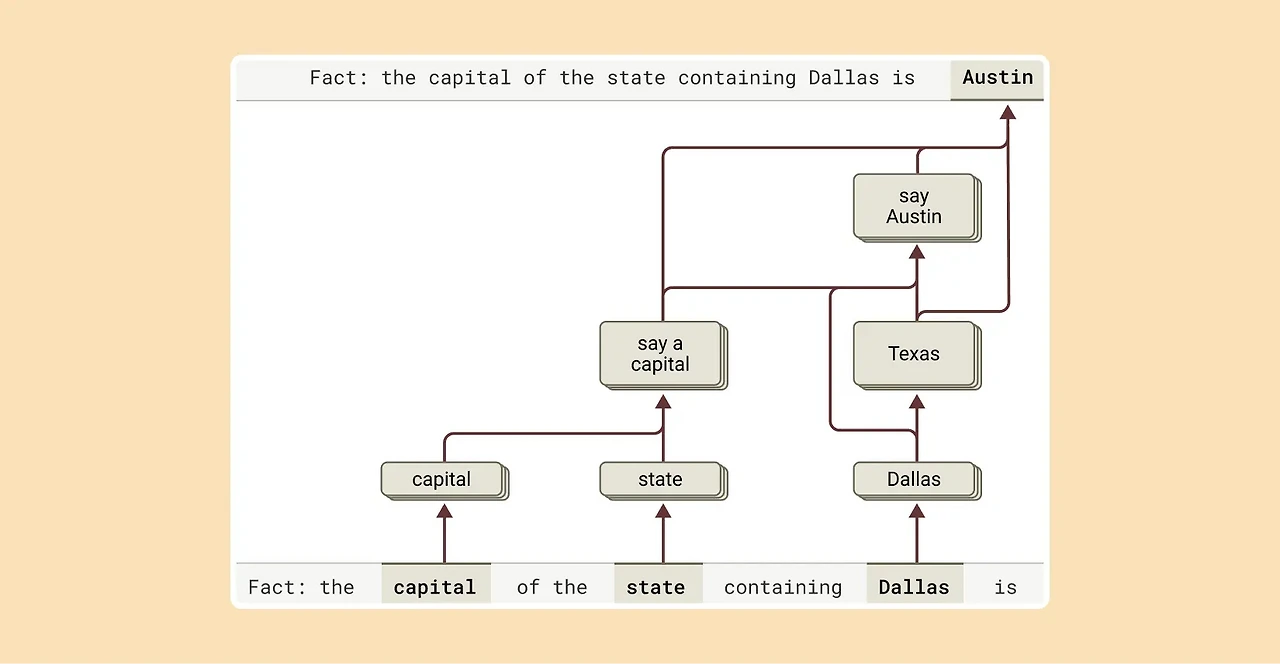
To complete the answer to this sentence, Claude performs multiple reasoning steps, first extracting the state that Dallas is located in, and then identifying its capital. Our method allows us to artificially change the intermediate steps and see how it affects Claude’s answers. For instance, in the above example we can intervene and swap the "Texas" concepts for "California" concepts; when we do so, the model's output changes from "Austin" to "Sacramento." This indicates that the model is using the intermediate step to determine its answer.
Hallucinations
Why do language models sometimes hallucinate—that is, make up information? At a basic level, language model training incentivizes hallucination: models are always supposed to give a guess for the next word. Viewed this way, the major challenge is how to get models to not hallucinate. Models like Claude have relatively successful (though imperfect) anti-hallucination training; they will often refuse to answer a question if they don’t know the answer, rather than speculate. We wanted to understand how this works.
It turns out that, in Claude, refusal to answer is the default behavior: we find a circuit that is "on" by default and that causes the model to state that it has insufficient information to answer any given question. However, when the model is asked about something it knows well—say, the basketball player Michael Jordan—a competing feature representing "known entities" activates and inhibits this default circuit (see also this recent paper for related findings). This allows Claude to answer the question when it knows the answer. In contrast, when asked about an unknown entity ("Michael Batkin"), it declines to answer.

Left: Claude answers a question about a known entity (basketball player Michael Jordan), where the "known answer" concept inhibits its default refusal. Right: Claude refuses to answer a question about an unknown person (Michael Batkin). By intervening in the model and activating the "known answer" features (or inhibiting the "unknown name" or "can’t answer" features), we’re able to cause the model to hallucinate (quite consistently!) that Michael Batkin plays chess.
Sometimes, this sort of “misfire” of the “known answer” circuit happens naturally, without us intervening, resulting in a hallucination. In our paper, we show that such misfires can occur when Claude recognizes a name but doesn't know anything else about that person. In cases like this, the “known entity” feature might still activate, and then suppress the default "don't know" feature—in this case incorrectly. Once the model has decided that it needs to answer the question, it proceeds to confabulate: to generate a plausible—but unfortunately untrue—response.
'LLMs > Interpretability' 카테고리의 다른 글